Showing posts with label Queen Elizabeth I. Show all posts

Friday, 3 October 2025

THE RENAISSANCE - 4^C LINGUISTICO


The Renaissance was one of Europe’s most significant historical periods, and is often characterised by the magnificent outpouring of art, literature, and scientific developments witnessed between the 15th and 17th centuries.

During this time new ideas spread across the continent, focused on the possibilities of mankind, the achievements of the individual, and the teachings of the ancient world – pushing Europe out of the "Dark Ages" and towards a more enlightened and modern society.  Read here.

Renaissance drama


Here you can find some useful Powerpoint presentations.


Tuesday, 11 October 2022

THE ENGLISH RENAISSANCE - 4^C LINGUISTICO

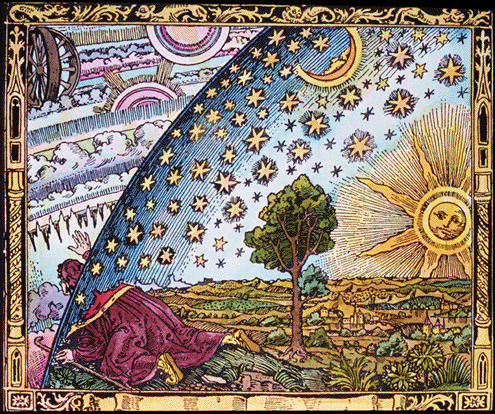
Risultati immagini per renaissance copernicus

The Renaissance – that cultural, political, scientific and intellectual explosion in Europe between the 14th and 17th centuries – represents perhaps the most profoundly important period in human development since the fall of Ancient Rome. Read here.

The word renaissance literally means "rebirth." In the context of the English Renaissance, this rebirth refers to a renewal of learning, especially in terms of new beliefs and ways of doing things differently from the Middle Ages. Characteristics of the Renaissance include a renewed interest in classical antiquity; a rise in humanist philosophy (a belief in self, human worth, and individual dignity); and radical changes in ideas about religion, politics, and science.
The Elizabethan Age as part of the Renaissance period saw the development of Elizabethan poetry and drama as well as  the stability and prosperity of England. The Queen supported development of art which contributed to the emergence and recognition of individuals such as William Shakespeare and Ben Johnson. She also supported exploration by authorizing the voyage by Sir Francis Drake around the globe. Discover more here.


Wednesday, 24 March 2021

QUEEN ELIZABETH I

Queen Elizabeth I died on 24 March 1603. Elizabeth, the last Tudor monarch and "Virgin Queen", was the daughter of Henry VIII and his second wife, Anne Boleyn. She became queen in 1558 aged 25 and ruled for 45 years. Her reign saw the defeat of the Spanish Armada, the introduction of a revised Book of Common Prayer and a golden age of playwrights and poets. Read here.

"Though the sex to which I belong is considered weak you will nevertheless find me a rock that bends to no wind."


Sunday, 15 October 2017

DISCOVERING ELIZABETHAN ENGLAND


Today let's watch an insightful documentary on Elizabethan England. Click here.
If you need to revise the Elizabethan Age, click here.


Sunday, 7 September 2014

QUEEN ELIZABETH I


Called "Gloriana" by Edmund Spenser in The Faerie Queene, Elizabeth I, whose name has become a synonym for the age she dominated (1558-1603), was born on 7 September 1533 to Henry VIII and Anne Boleyn. At the time of her coronation in 1558, England was a weak, divided kingdom far outside the mainstream of European power and cultural development, however Elizabeth's political skills and strong personality were responsible for putting England on the road to becoming a world economic and political power and restoring the country's lost sense of national pride. She inherited her father's all-powerful view of the monarchy, but showed great wisdom by refusing tarouse hostility in Parliament. She obtained never-ending devotion from her Privy Council, who were constantly confused by her habit of waiting to the last minute to make decisions - a tactic that she used to advantage. She used the various factions, playing one off another until they came to her to solve their disputes. Few English sovereigns enjoyed such great political power, while still maintaining the devotion of the whole of the country.

Here you can download a biography of Elizabeth I.