Showing posts with label The Renaissance. Show all posts

Friday, 3 October 2025

THE RENAISSANCE - 4^C LINGUISTICO


The Renaissance was one of Europe’s most significant historical periods, and is often characterised by the magnificent outpouring of art, literature, and scientific developments witnessed between the 15th and 17th centuries.

During this time new ideas spread across the continent, focused on the possibilities of mankind, the achievements of the individual, and the teachings of the ancient world – pushing Europe out of the "Dark Ages" and towards a more enlightened and modern society.  Read here.

Renaissance drama


Here you can find some useful Powerpoint presentations.


Thursday, 3 October 2024

SONNET 130


Shakespeare's Sonnet 130 is an anti-Petrarchan love poem that uses a mocking and realistic tone to subvert the exaggerated and idealized conventions of traditional sonnets. Instead of using grand metaphors to describe his beloved, the speaker lists her ordinary, non-ideal features, such as eyes not as bright as the sun and lips less red than coral, to argue that his love is more genuine because it is based on reality, not hyperbole. The poem concludes in the final couplet by asserting that despite her lack of conventional beauty, his love is as valuable as any "false compare" used by other poets.

https://www.bbc.co.uk/bitesize/guides/zpkytv4/revision/1

Here and here you can read a short commentary on this sonnet.


Wednesday, 2 October 2024

SONNET 18


It is the best known and most well-loved of all 154 sonnets. It is also one of the most direct in language and intent.

The poet starts the praise of his dear friend without ostentation, but he slowly builds the image of his friend into that of a perfect being. He is first compared to summer in the octave, but, at the beginning of the third quatrain (line 9), the speaker states with a renewed assurance that “thy eternal summer shall not fade” and that his friend will preserve his beauty and even cheat Death and Time by becoming eternal. He achieves this through his sonnet. The final couplet reaffirms the poet's hope that as long as there is breath in mankind, his lines too will live on, and ensure the immortality of the “fair youth”.

Here  and here you can read a short commentary on this sonnet.


Tuesday, 11 October 2022

THE ENGLISH RENAISSANCE - 4^C LINGUISTICO

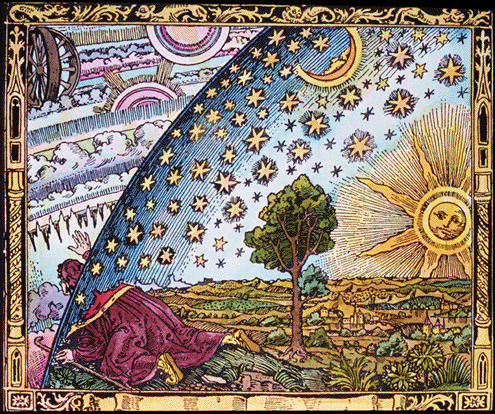
Risultati immagini per renaissance copernicus

The Renaissance – that cultural, political, scientific and intellectual explosion in Europe between the 14th and 17th centuries – represents perhaps the most profoundly important period in human development since the fall of Ancient Rome. Read here.

The word renaissance literally means "rebirth." In the context of the English Renaissance, this rebirth refers to a renewal of learning, especially in terms of new beliefs and ways of doing things differently from the Middle Ages. Characteristics of the Renaissance include a renewed interest in classical antiquity; a rise in humanist philosophy (a belief in self, human worth, and individual dignity); and radical changes in ideas about religion, politics, and science.
The Elizabethan Age as part of the Renaissance period saw the development of Elizabethan poetry and drama as well as  the stability and prosperity of England. The Queen supported development of art which contributed to the emergence and recognition of individuals such as William Shakespeare and Ben Johnson. She also supported exploration by authorizing the voyage by Sir Francis Drake around the globe. Discover more here.


Monday, 21 March 2022

RICHARD III - 4^C LINGUISTICO


Here  you can download a PDF presentation of Shakespeare's historical drama, Richard III.

Here you can find lots of material to revise the play  as well as some teaching material from The Old Vic Theatre Company here.

Tuesday, 28 December 2021

REVISING ELIZABETHAN THEATRE AND DRAMA

During Elizabeth I’s reign English playwrights began to write comedies and tragedies. By the end of her reign playwrights such as Marlowe, Johnson and Shakespeare were writing the plays for which they are now famous. Read here.

https://nosweatshakespeare.com/resources/era/elizabethan-theatre-drama/

Friday, 23 April 2021

HAPPY BIRTHDAY, WILLIAM SHAKESPEARE!

William Shakespeare was a renowned English poet, playwright, and actor born in 1564 in Stratford-upon-Avon. His birthday is most commonly celebrated on 23 April, which is also believed to be the date he died in 1616.

Shakespeare was a prolific writer during the Elizabethan and Jacobean ages of British theatre (sometimes called the English Renaissance or the Early Modern Period). Shakespeare’s plays are perhaps his most enduring legacy, but they are not all he wrote. Shakespeare’s poems also remain popular to this day. Read here.

Wednesday, 24 March 2021

QUEEN ELIZABETH I

Queen Elizabeth I died on 24 March 1603. Elizabeth, the last Tudor monarch and "Virgin Queen", was the daughter of Henry VIII and his second wife, Anne Boleyn. She became queen in 1558 aged 25 and ruled for 45 years. Her reign saw the defeat of the Spanish Armada, the introduction of a revised Book of Common Prayer and a golden age of playwrights and poets. Read here.

"Though the sex to which I belong is considered weak you will nevertheless find me a rock that bends to no wind."


Tuesday, 5 January 2021

TWELFTH NIGHT


Many Christians around the world celebrate Epiphany on 6 January. It is a public holiday in many countries and marks some events in Jesus Christ’s life, according to the Christian Bible. Continue reading here.

In medieval and Renaissance England one of the main Christmas celebrations was Twelfth Night, which coincided with the feast of Epiphany.
In this regard, Shakespeare’s Twelfth Night takes its name from the English holiday celebrated on the eve of 5 January, the so-called "twelfth night of Christmas" or the Feast of the Epiphany. Read here and here.

Thursday, 26 December 2019

A TUDOR FEAST AT CHRISTMAS


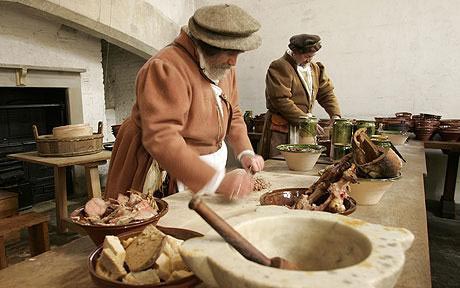
Here you can read about the foods enjoyed by the upper classes in Tudor England. Read another interesting blog post here.
Now let's watch a documentary about a Tudor feast as it would have been over 400 years ago. 


Saturday, 23 November 2019

ANALYSING SHAKESPEARE'S SONNETS

Risultati immagini per shakespeare sonnets volume cover

Shakespeare’s sonnets are some of the most fascinating and influential poems written in English. First published in 1609, in a small quarto edition (roughly the size of a modern paperback), almost nothing is known about the poems’ composition. Read more here.
All the sonnets are provided here, with descriptive commentary attached to each one, giving explanations of difficult and unfamiliar words and phrases, and with a full analysis of any special problems of interpretation which arise.


Wednesday, 30 October 2019

SHAKESPEARE'S SONNETS


The Sonnets are Shakespeare's most popular works, and a few of them, such as Sonnet 18 (Shall I compare thee to a summer's day),  Sonnet 73 (That time of year thou mayst in me behold) and Sonnet 116 (Let me not to the marriage of true minds),  have become the most widely-read poems in all of English literature. Here you will find the text of each Shakespearean sonnet with commentary for most.

Tuesday, 15 October 2019

THE ELEMENTS OF DRAMA


A play is a form of literature written intentionally for theatrical performance. Most of the parts in a play are dialogues between characters intended to be performed by actors and actresses to move the story along. 
There are six main elements of drama which serve as the basis of producing a successful play.  Altogether, they provide a building block by which dramatic works can be analyzed and evaluated. By knowing and using the elements of drama, the skills needed in creating a successful performance, as well as the skills required to analyze a drama, could be developed. 

The followings are the elements of drama and their brief description:

Plot  
Referring to the basic storyline of the play, the plot is the structure of a play which tells what happens as the story goes on. The plot structure can be divided into six stages: 
  • The exposition is simply an introductory part that provides the background information needed to properly understand the story. 
  • The inciting incident, or conflict, is the event that sets the action of the play in motion. It is what gets the story going. 
  • The rising action is a series of events, including complications and discoveries which create the dramatic climax of a plot.
  • The climax is the turning point, or the peak, of a plot which holds an utmost emotional intensity of the play. 
  • The falling action is a series of events following the climax that leads to the solution of the conflicts.
  • The denouement serves as the conclusion of the plot in which the conflicts are resolved. It is the ending scene of the drama. 

Character
Characters are the people, or sometimes animals, who are portrayed by the actors and actresses in the play. They are one of the main components that move the action of the play forward. Characters can be categorized into three types according to the roles they play. The main character of the play is known as the protagonist. The antagonist is the character who opposes the protagonist. The other characters are called the secondary characters. They may have a major part or a minor involvement in the drama.

Setting
The setting is the place, together with other conditions, such as time and the environment, involved in which the events occur. The setting can be presented through the visual elements which deal with the scenes, costumes and special effects used in it. The setting can also be enhanced by using  sound effects and music.

Theme
The theme refers to the message that is intended to be expressed through the story. In other word, it is the main idea or the lesson to be learned from the play. 

Genre
Genre is the type of play. The examples of genre in which the play can be classified include tragedy, comedy, romantic, mystery, and historical play.  

Audience
Audience is a group of people who watch the play. Audience can be said to be the most important element of drama to be considered about, since it is the audience that determine whether the play is successful or not. Also, many playwrights write the plot of the play with a great concern regarding to their groups of audience rather than their own interests. 

Here you can find my previous post about the basic elements of drama.

Tuesday, 8 October 2019

THE ELIZABETHAN AGE - THE CHAIN OF BEING


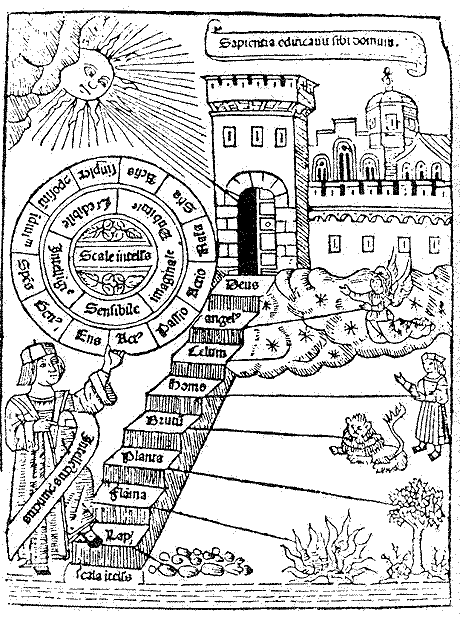
The Chain of Being or scala naturæ is a classical conception of the metaphysical order of the universe in which all beings from the most basic up to the very highest and most perfect being are hierarchically linked to form one interconnected whole. Read more here.