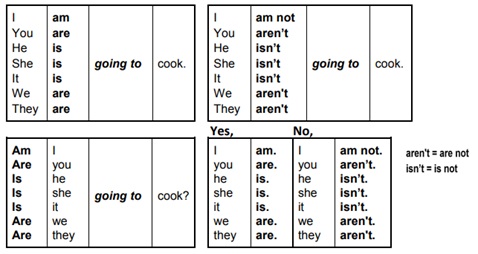
We can express the future with BE GOING TO +
infinitive.
Here are some examples to make
sure this is clear:
- I’m going to see a play tonight.
- It's late so I don't think he's going to
do his work tonight.
- Look at those clouds. It's going to
rain soon.
- My favourite team is going to
play tomorrow evening.
To form questions, we invert the subject (e.g, I,
you) and "is/am/are." If we use a wh- question word, we insert it at
the beginning of the sentence:
- Who is going to read the next paragraph?
- Are you going to speak at the conference?
- What is she going to cook for dinner?
- Are they going to sleep all day?
- Where is your brother going to sleep when
he visits you?
The structure BE GOING TO is normally
used to indicate the future but with some type of connection to the
present.
We use it in the following situations:
1. When we intend / plan to do something in the future.
The decision has been made before the moment of
speaking.
- They're going to retire to the beach - in
fact they have already bought a little beach house.
- I'm going to accept the job offer.
- Next week I'm going to start a new
diet.
- Are you going to come to my party
tomorrow?
2. When there are definite signs that something is going to
happen.
Something is likely to happen based on the evidence
or experience you have.
- I think it is going to rain - I just
felt a drop!
- I don't feel well! I think I'm going
to throw up (= vomit).
- I got a D on my exam. My parents are
going to kill me!
3. When
something is about to happen:
- Get back! The bomb is going
to explode.
- Look out! That car is going to overtake.


